Make a sea of ruffles using a ribbon yarn and a base yarn.
Subscribe to My Crochet Channel or go to: YouTube.com TanisGalik
Video: Simple & Sensational™ – Red Garland Boa
Written Pattern: Simple & Sensational™ – Red Garland Boa
Start by carefully unwinding the TuTu Lamé skein (or any ribbon yarn) and rewind the ribbon on a piece of cardboard, keeping the ribbon flat and untangled. Smooth the ends or cut them off.
With Panda Silk or your foundation yarn chain 21 (or desired number), single crochet in second chain from hook and single crochet in each chain. You now have your base. Chain two and turn.
Normally you would chain three and it would count as your first double crochet—but not in this pattern. Yarn over and insert hook under the top two loops of the first single crochet. (Do not skip the first single crochet.)
 Pick up your ribbon yarn and begin by folding at least two top loops or ladders over. (The loops or ladders run along the top of the ribbon yarn.) Fold it over so the end is on the inside. Always run the ribbon along the back of the base. Put the ribbon against the back of the base and continue inserting the hook through the first ribbon ladder, yarn over and pull through the ribbon ladder and the single crochet. There are three loops on the hook. Yarn over and pull through two loops on the hook twice. You have completed a regular double crochet.
Continue working along the base uniting the ribbon to the back of the base with a double crochet. Of course, the loops or ladders are spaced farther apart than the base stitches. This is what creates the dense ruffles. Be sure not to work double in the same loop or ladder. Also, after you finish each row, very gently pull your ruffles down to help even off the mesh that hangs down.
When you reach the edge of your base, chain two and turn. Be sure to pull your ribbon flat and untwisted against the back as you turn. Continue working double crochets as before. Don’t skip that first double crochet, but work into the first stitch. All rows are now double crochets.
When you reach the end of the last row, work just as you did in the beginning. Fold over the last two or three ribbon ladders. This gives you a clean edge at the beginning and end.
This technique creates beautiful ruffles you can use as a scarf, an edging on another item or as a larger all-ruffles project.
 After crocheting your running chain stitch, put your hook under the stitch loops. Use those loops to crochet over so the decoration is attached directly to your project instead of attaching it later.
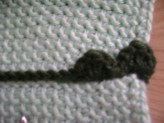 Crochet a line of running chain stitches and working back over the chain loops with single crochets. This creates a plain, raised edge which can be used as a stem or to create a line design.
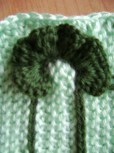 Make six double crochets in each loop and create a big ruffle. Make it thicker or thinner depending on how many stitches you use. Make it higher or lower depending on the crochet stitch used—a half double crochet, double crochet or triple crochet. Experiment to achieve whatever design you want.
 Crochet a flower right on your project. Start in the center and made a spiral with a running chain stitch. When you get to the end (because you’re not at the edge of the item), pull up a loop of yarn from the back next to the last stitch. This is the yarn loop you will be working with. Work back over the running chain with a single crochet in each chain loop. At the center start working out again over the single crochets. For the rose in the picture, I worked four half double crochets in each single crochet, resulting in a thick ruffled rose.
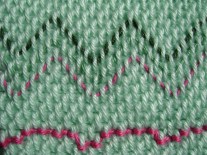 What you’ll notice about the waffle stitch is it has two vertical bars. There’s a prominent forward bar and a not-so-prominent back bar. In this design I’m running the yarn under the prominent bar. My favorite is the zigzag design, using the running stitch in yarns of dark green, medium green and pink. Of course, you could add more and more rows or you could actually reverse the design, creating a diamond pattern.
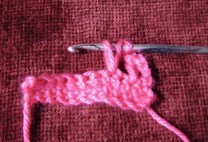 For an elongated double crochet begin my making a normal double crochet. Yarn over and go under the top two loops of your next stitch. Yarn over and pull through. The only difference is you elongate this loop. Make it at least a half inch long or longer if you choose. Yarn over and pull through two loops on the hook twice. It’s a double crochet but you elongated it for a more open, lacy look.
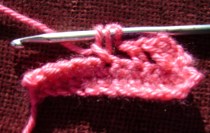 For an extended double crochet begin by making a normal double crochet. Yarn over and insert the hook under the top two loops of your next stitch. Yarn over and pull through. There are three loops on the hook. Normally you yarn over and pull through two loops on the hook twice. However, for the extended double crochet pull through only one loop on the hook. Then yarn over and pull through two loops on the hook twice. It makes a longer or higher than normal double crochet.
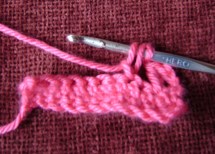 You can also extend other crochet stitches. A single crochet can be extended by beginning a normal single crochet. Insert your hook under the top two loops of the previous row’s stitch, yarn over and pull through. There are two loops on the hook. Yarn over, but instead of pulling through two loops, pull through only one loop on the hook. Then yarn over and pull through the two remaining loops on the hook. You’ve extended your single crochet so it is higher than a normal single crochet.
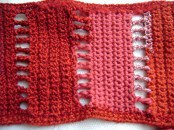 These simple additions give you some new ways to use basic crochet stitches.
 You can find several patterns at their website; however, here is the one I’ve used:
 To begin the ribbon row, fold the ribbon yarn over so at least three loops or ladders are doubled. Since you’re starting on the front, the double edge is to the back.
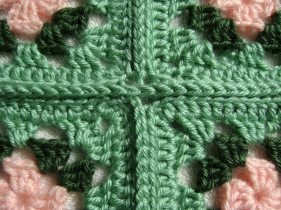 For this granny square grouping, I’ve joined the granny squares or motifs with single crochets worked through the back loop of the front granny square and the front loop of the back granny square. Try to match the stitches as best you can as you work along the motif’s side. When you arrive at the place where the ridges meet, continue to work your join on one side of the ridge connecting the two adjacent granny squares. Without making a stitch, skip over the ridge and continue connecting the next two adjacent granny squares in the same manner. When you stretch your fabric, you’ll see a clean meeting of all four corners.
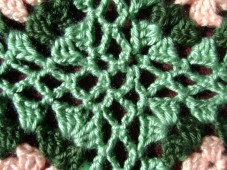 For the first corner join, you attach granny square #1 with granny square #2. When you attach granny square #3 and #4, you work around each motif and attach it to only one granny square on each side. At the corner you do not attach the granny square or motif diagonally across. What will usually happen in this type of join? There is a space where the four corners meet. If the space isn’t that noticeable (as in this sample), it will become part of the design. However, depending on the pattern, if the empty space is quite large, a smaller motif is often added to fill this space. On the next two corner joins that space will be filled.
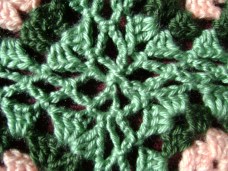 For the second corner join you attach each motif as before, however, when you reach the corner, you will work so motif #3 and #4 will be attached to the motif diagonally across. For motif #4 you can make your single crochet by wrapping it around all the joins at the diagonal corner. But sometimes it can look a little lumpy. You will have to experiment yourself to see it this type of corner join works for your project.
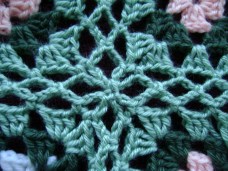 I personally prefer the third corner join. Work around as in the second corner join above, filling the empty space with the diagonal join. However, for motif #4’s corner join, I will go through the center of where all the stitches are connected, making my single crochet by inserting my hook into the center of the stitches. Then I turn my work and continue working the joining technique down the side. When I stretch the fabric out, it’s going to have a small design filling the space.
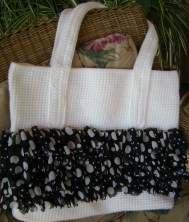 Black and white is all the rage so wear it well in a tote with fabric yarn ruffles. This polka-dot fabric yarn certainly adds personality to an everyday tote. It’s available now in a magazine or crafts store near you. Or go to
  I’m proud to say my design – Gingham Afghan, a bit of Scottish elegance for your home – can be found on page 34. (For a demonstration on how to create a mesh foundation or how to perform the woven technique, check out these videos.)
 Tanis Galik - Crochet Teacher