Purple Stitch Project (PSP) was founded by designer, author and on-air personality, Vickie Howell, who is best known as the host of DIY Network’s Knitty Gritty and the spokesperson for the yarn company, Caron International.
Subscribe to My Crochet Channel or go to: YouTube.com TanisGalik
In 2011, Vickie’s youngest son, Tristan was diagnosed with epilepsy after an EEG test proved that the “grand mal” seizure he’d had was not a fluke. According to the Epilepsy Foundation, epilepsy affects more than 300,000 children in the U.S., but for any one kid who has the disorder it can feel pretty isolating. Vickie noticed this feeling in her own son, and began work to help him feel less different and alone. While reaching out to form a community for Tristan, she met other children with varying degrees of seizure disorders. She decided that she wanted to do something that would help raise their spirits, so she drew from what she’s knows best: the handmade world. Thus, the idea for Purple Stitch Project was born.
Purple Stitch Project (PSP) is a web-based charitable organization to benefit babies, children and teens with epilepsy. The first goal of this initiative is a call to action for people who knit, crochet, or sew to make purple (the epilepsy awareness color) gifts for kids with seizure disorders. These gifts will serve as a reminder that they are not alone — that they have community support. To do this, Purple Stitch Project has teamed up with Craftsy to be able to offer free patterns and project ideas for volunteers to work from.
Who will benefit from your handmade item? Currently, PSP will be working with the Specially for Children Neurology offices, the Epilepsy Monitoring Unit in Austin, TX, and the EFSCT who will distribute the items to patients. It’s their plan to make this a national outreach program as soon as possible.
In the meantime, if you know an individual child or organization who might benefit from a Purple Stitch Project handmade treat, please send info to: psp@vickiehowell.com . She’ll do her best to hook them up!
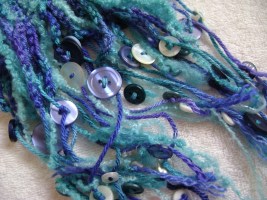 As you can see, the fringe in this picture has buttons added to it. Whether you have a collection of buttons you’ve saved over the years or buy packets of buttons especially for your project, it’s an easy decoration that adds punch and a bit of fun to any scarf or purse.
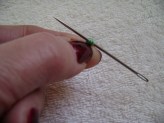 The best way to thread the needle is to wrap it very tightly around the base of the needle. Then holding the fold between your fingers, push the folded end through the eye (demonstrated in video).
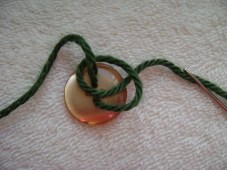 If you have a specific spot where you want the button located, first tie a knot in that spot. Thread your button as you normally would – sewing from back to front and front to back through the button’s holes. Move the button to the knot. Turn it over. Then wrap your needle behind the knot, put the needle through the thread loop and tighten. You’ve created a second knot over the first one and your button is securely in place.
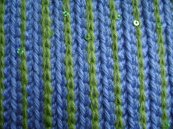 You can use yarn with sequins as I did on this scarf to create eye-catching straight lines.
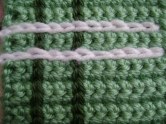 You can also create a plaid effect. Work a couple of rows of single crochet in one color and then alternate between two or more colors to create stripes. Turn your project sideways and use the running chain stitch in various colors to create a plaid.
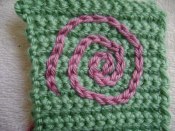 You can make other designs also. Pull a loop through the center of your fabric instead of starting at the edge and make a spiral design. The possibilities are only limited by your imagination.
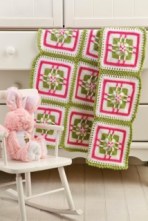 This cheery blanket with its fresh watermelon colors will brighten any nursery and would make a beautiful gift for a new mom-to-be.
 I took a flat piece of wood, cleaned it, making sure it was smooth. My squares were twelve inches by twelve inches so I took my measuring yardstick and a permanent marker (since I didn’t want the ink to come off on my project) and marked every half inch along the square’s edges. However, when I began to pound the nails in, I realized I only needed my board to have a nail every inch.
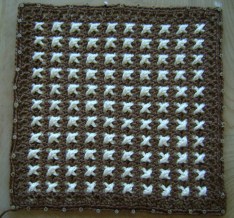 I took an old face cloth and placed it inside the nail square. Then I picked up my motif, looped each corner of the motif over the corner nails. Next I looped along each edge, stretching the motif as I went. When I finished, I could either steam the motif or spray it with clear water. I sprayed with clear water until the motif was damp. When dried, I easily lifted the loops over the nail heads.
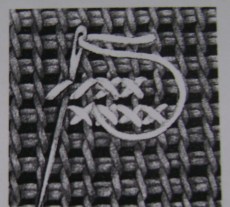 Work over the bars of the mesh in a basic cross stitch design. The technique is illustrated in the picture. Stitch all diagonals in one direction and then return in the opposite direction. What is important is that you consistently make your stitches the same way.

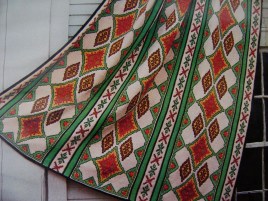
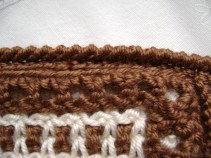 Normally, I work from the right to the left so I would be crocheting my single crochet in that direction also. However, for the crab stitch, I’m going to work in the opposite direction. (Right-handed individuals work right to left normally, but now you will work left to right. Left-handed individuals work left to right, but now you will work right to left.)
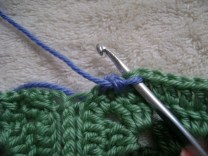 Continue making a regular single crochet, just reverse the direction. Go under the two top loops of the stitch to your right (for right-handed) or to your left (for left-handed). Yarn over and pull through so you have two loops on your hook. Yarn over and pull the two loops on your hook. Continue working this way around your crocheted project. As you work, you will see a cord edging form. It is very easy to do and it creates a simple but attractive finish to any crocheted project.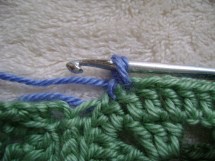
 Tanis Galik - Crochet Teacher