Adding ruffles to any Tunisian or Afghan Stitch is easy and offers more options for decorating your crocheted projects.
Subscribe to My Crochet Channel or go to: YouTube.com TanisGalik
Video: Mesh Ruffle Added to Afghan/Tunisian Simple Stitch
Video: Complete Edge of Ruffle Added to Afghan/Tunisian Stitch Panel
Video: Afghan or Tunisian Crochet Basic Stitch
Video: Afghan or Tunisian Crochet – Create a Finished Edge on all Sides
Blog: Afghan or Tunisian Crochet – Basic Stitch
Blog: Afghan or Tunisian Crochet – Create a Finished Edge on All Sides As You Work
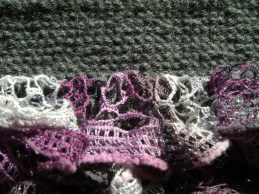
Though I’m working on the front, I’m adding the ruffles to the back. When turned around, the back will become the front – a textured basic fabric with rows of ruffles.
It is important is to know how many loops you start with on your Afghan hook That number will be important because after adding the ruffle row, it is very easy to add or decrease stitches on the next cast-on row. (If you need to learn how to crochet an Afghan Basic or Tunisian Simple Stitch, the videos and blogs listed above will help you.)
To begin, cast on the first three stitches so you have a plain edge. Work in the second row of your mesh yarn ladders instead of the first row to add strength. Leave a tail of mesh yarn (at least three spaces) at the beginning and end of each ruffle row since the tails will be carried around the panel and secured on the back.
Place the working yarn behind the mesh so it will hold the mesh yarn in place. After completing the first three Tunisian Simple Stitches, slide a mesh ladder loop onto the hook. Work the next Basic Afghan/Tunisian Simple Stitch. Add the next mesh ladder loop on the hook. Continue across alternating between the Tunisian Simple Stitch and adding a mesh ladder loop on the hook. Work the last three stitches in Tunisian Simple Stitch as in the beginning of the panel. Leave a tail of mesh yarn long enough to wrap around the back for securing later. Cut mesh yarn.
The next row is a basic cast-off row. However, there will be more stitches on your hook in the row because of adding the mesh yarn loops. Continue to cast off as normal whether it is regular yarn or mesh yarn loops. They are treated the same.
The next cast-on row will be worked ONLY picking up the Tunisian Simple Stitches. Do not include the mesh yarn loops. After completing the row be sure to count the number of loops on the hook to ensure it will match the original number you started with. This is where is it is easy to add or decrease loops, especially if the colors of both the yarns are similar. It is important to count after each mesh ruffle row is added.
Continue working Tunisian Simple Stitch rows until you are ready for your next ruffle row.
Depending on how wide your mesh yarn is or how much space you want between the ruffles, work plain Tunisian Simple Stitch rows in between ruffle rows. For my panel because the ruffle mesh was large, I worked five Tunisian Simple Stitch rows between the Ruffle Row. On the sixth row I added the ruffles because I wanted a fluffy tiered effect. You may want a different effect or have a thinner, ribbon yarn. The choice is yours.
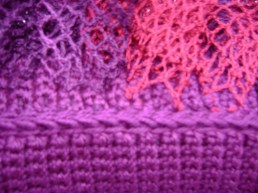
To finish your panel, turn it around so the back becomes the front with a textured basic fabric and rows of ruffles. Work around the panel with a single crochet row and three single crochets in each corner. (You can use any crochet stitch to finish the panel’s edge.) When you reach the ruffle row, the mesh yarn tail is located between two single crochets. Take the tail and pinch it together between the single crochet rows. Do not work into the ruffle row. Instead, skip the ruffle tail and work a single crochet into the stitch on the other side of the ruffle tail. Do not skip or add any stitches. Continue working single crochets along the edge until you come to another ruffle row and repeat.
To complete the ruffle, secure the tail to the back of the panel. Don’t pull the tail tight. Allow the ruffle to hang naturally so it matches the other ruffles. Turn to the back, twist the tail into a compact unit. With a needle and thread sew back and forth and tack it down to the back of the panel. Be careful not to let the thread show through to the right side.
Incorporating mesh yarn or ribbon yarn ruffles is easy to do, but it can add a designer look to any crocheted project.


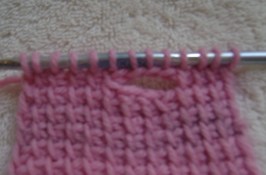
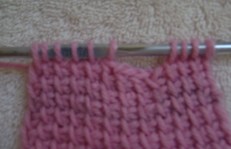 Cast on normally across the row, working to the spot where you want to add the buttonhole. Cast one more loop on the hook for the beginning edge of the buttonhole. Work three single crochets across the next three blocks. (Insert the hook under your next front bar, yarn over, pull a loop on the hook, yarn over and pull it through the last two loops on the hook to make a single crochet.)
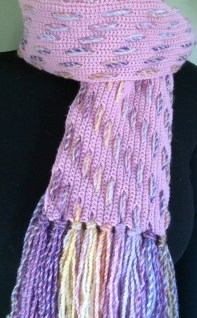 Over the past month I’ve been making scarves to donate to various charities. One design has a simple single crochet base with chain stitch eyelet spaces.
 Over the past month I’ve been making scarves to donate to various charities. Each scarf needed to be unique so I came up with this 3-in-1 design using a basic double crochet pattern as the fabric base.
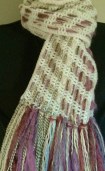 Follow the brick design or work the diagonal weave design (both found in the pattern) and create a one-of-a-kind, eye-catching scarf. Add fringe in the various woven yarns and you have a beautiful gift for yourself or a loved one.
 I’m using single crochets, but you can use any stitch appropriate for your project. Work as normal along one side of the foundation chain. However, when you get to the end, instead of chaining one and turning to work another row for single crochets, make three single crochets (or appropriate stitch) in the last stitch, creating a rounded end. Continue to work along the opposite side of the foundation chain using the loops that are left. Weave in the yarn tail as you work so you don’t have to weave it in later.
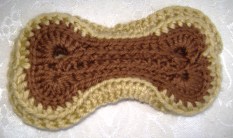 I’ve used this technique to make a doggy bone toy for my dog. The free pattern is found under Simple & Sensational patterns – Doggie Biscuit Toy.
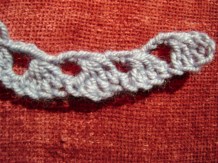 One of the main differences of the cluster stitch – it’s worked over several chains or stitches. Unlike the bobble or popcorn which is worked into one chain or stitch, the cluster can be worked over 3, 4, 5 or more chains or stitches. Always check with your pattern to see how many prongs are used in the cluster. For your own designs, obviously the more prongs, the puffier the cluster.
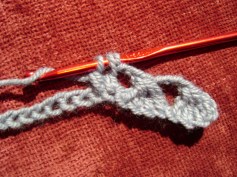 Begin with a yarn over, insert hook into one chain or stitch. Yarn over and pull through. Yarn over and pull through two loops on the hook. Do not complete the double crochet. Repeat over the next desired number of chains or stitches, leaving the unused loops on the hook. When you have completed the required prongs for your cluster, yarn over and pull through all loops on the hook. Lock the cluster with a slip stitch. Always check your pattern, the design may finish or close the cluster differently.
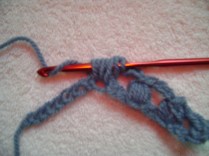 The Puff Stitch is worked into one chain or stitch. Yarn over, insert hook into the space, yarn over and pull through a loop on your hook. Stretch the loops up. Repeat this process until you reach the number of desired loops on your hook. Depending on the pattern and how puffy you want the stitch, there could be 7, 9 or more loops on your hook. It is good to give the loops an extra stretch so you have room. Yarn over and pull through all the loops on your hook. Lock the puff with a slip stitch.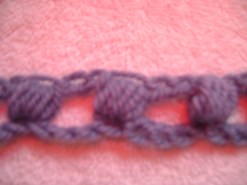
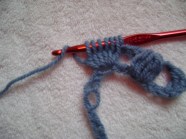 The Bobble is worked into one chain or stitch. I’m using a double crochet; however, a longer stitch may be required for your pattern or design.
 It creates a great and simple decorative stitch that adds dimension to your designs.
 Tanis Galik - Crochet Teacher